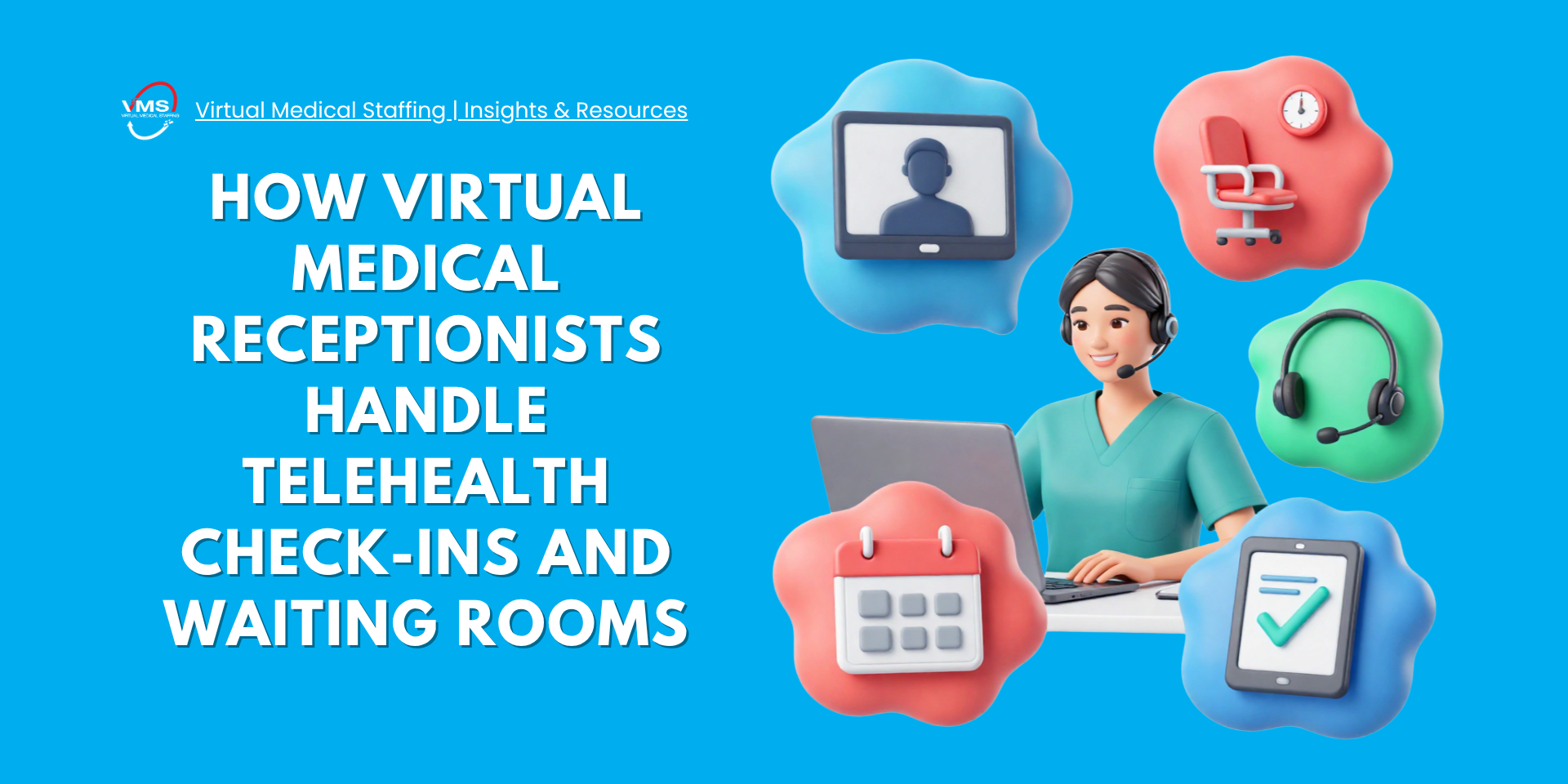
A virtual medical receptionist manages telehealth check-in by verifying patient identity and appointment details, collecting updated intake and consent forms, troubleshooting login or connection issues, and monitoring the digital waiting room until the provider is ready. They also confirm insurance and co-pay information, flag urgent concerns to the care team, and coordinate follow-up after the visit — handling the same front-desk responsibilities as an in-person receptionist, just through a screen instead of a counter.
Telehealth has changed how patients reach their providers, but it hasn’t removed the need for a human at the front desk — it’s just moved that front desk online. Practices that treat telehealth like a purely technical rollout (get the video platform running, hope for the best) tend to see the cracks show up fast: patients stuck in login loops, missing consent forms, providers walking into visits with no pre-visit notes. A virtual medical receptionist (VMR) closes that gap. Below is a step-by-step look at how they manage the telehealth check-in process from login to follow-up, along with the data behind why this role has become a standard part of virtual care operations.
Why Telehealth Check-In Support Matters Right Now
Telehealth adoption isn’t a pandemic-era blip — it’s become baseline infrastructure. Among office-based physicians, use of video telemedicine for patient care jumped from 16.0% in 2019 to 80.5% in 2021, according to the National Center for Health Statistics. And patients aren’t just tolerating virtual visits — they’re choosing them. When the American Hospital Association asked patients why they use telehealth, convenience topped the list at 65%, followed by faster access to care at 46%.
That said, adoption and satisfaction aren’t the same thing. Telehealth utilization patterns vary widely by age, insurance type, and region — HHS’s Office of the Assistant Secretary for Planning and Evaluation found utilization rates ranging from roughly 18% to 28% depending on the population studied, with the lowest rates among uninsured patients and young adults. In other words: the technology is available, but plenty of patients still need a guiding hand to actually use it well. That’s the role a virtual medical receptionist plays.
In-Office Front Desk vs. Virtual Medical Receptionist for Telehealth
| Task | Traditional In-Office Staff | Virtual Medical Receptionist |
|---|---|---|
| Patient check-in | Requires patient to be physically present | Verifies identity and appointment details remotely, before the visit starts |
| Waiting room management | Physical seating, sign-in sheets | Monitors a digital queue and sends real-time wait-time updates |
| Tech troubleshooting | Not typically equipped for platform issues | Trained to resolve login, audio, and video problems in real time |
| Document collection | Paper forms at the counter | Guides secure upload of labs, referrals, and consent forms |
| Coverage hours | Limited to office hours | Can extend coverage for after-hours or overflow telehealth blocks |
| Cost structure | Full-time salary, benefits, office space | Scalable, typically hourly or per-task |
This isn’t an either/or — most practices still need someone in the building. But for the specific workflow of getting a patient from “logged in” to “seen,” a virtual medical receptionist is purpose-built for the job in a way a generalist front-desk hire often isn’t.
The 7-Step Telehealth Check-In Workflow
Step 1: Digital Check-In
When a patient logs in for a telehealth appointment, the VMR greets them virtually, verifies their identity, and confirms appointment details. They collect necessary information — insurance details, medical history updates, or consent forms — before the provider ever joins the call.
- Verify patient identity and appointment details
- Collect updated medical history or consent forms
- Ensure providers receive accurate pre-visit data
Getting this right matters more than it might seem. A visit that starts with a provider re-asking questions the patient already answered, or discovering a missing consent form mid-appointment, erodes the convenience that drew the patient to telehealth in the first place — and convenience is the single biggest reason patients choose virtual care, per the AHA data cited above.
Step 2: Document Collection
Patients often need to upload lab results, prescriptions, or referral letters. The VMR guides them through the process, checks for completeness, and organizes files in the clinic’s system so nothing is missing when the provider opens the chart.
- Assist patients in uploading lab results or prescriptions
- Check documents for accuracy and completeness
- Organize files for provider access during consultation
Step 3: Tech Support for Patients
Not every patient is comfortable navigating a telehealth portal — and given that telehealth utilization skews lower among older adults and less tech-familiar populations, this step is often where a visit either happens on time or doesn’t happen at all. VMRs provide real-time assistance: helping patients log in, troubleshoot audio or video issues, or navigate the portal.
- Guide patients through login and platform navigation
- Troubleshoot audio/video connection issues
- Reduce frustration and prevent missed appointments
Practices that pair this kind of proactive support with structured outreach around missed and at-risk appointments tend to see fewer no-shows tied to tech friction specifically, since a patient who can’t figure out the login is functionally a no-show even if they intended to be there.
Step 4: Virtual Waiting Room Management
Just like in a physical clinic, patients may need to wait before seeing the doctor. VMRs monitor the virtual waiting room, update patients on expected wait times, and keep communication flowing so no one is left wondering if they’ve been forgotten.
- Monitor patient queue in the virtual waiting room
- Provide updates on wait times
- Share questionnaires or reminders to keep patients engaged
Step 5: Insurance & Billing Verification
Before the consultation, VMRs confirm insurance coverage and co-pay requirements. They oversee billing discussions, prepare accurate invoices, and make sure patients understand their financial responsibility before the visit — not after.
- Confirm insurance coverage and co-pay details
- Answer billing questions from patients
- Prepare invoices and ensure a smooth revenue cycle
This step often overlaps with dedicated insurance verification support, which many practices route through the same virtual staffing team to keep the financial and clinical intake process aligned.
Step 6: Provider Coordination
VMRs act as the communication hub between patients and providers. They notify doctors when a patient is ready, share pre-visit notes, and flag urgent concerns before the provider joins the call.
- Alert providers when patients are ready
- Share pre-visit notes and flagged issues
- Streamline communication between patient and doctor
Step 7: Post-Visit Follow-Up
After the consultation, VMRs schedule follow-up appointments, send prescriptions or lab requests, and answer any remaining patient questions — closing the loop on the visit instead of leaving it to the patient to chase down next steps.
- Schedule follow-up appointments
- Send prescriptions or lab requests
- Collect feedback to improve the telehealth experience
Ready to see this workflow running in your own practice? Book a free consultation and we’ll walk through what telehealth check-in support would look like for your patient volume.
Why This Workflow Matters
By mapping VMR tasks directly to the telehealth journey, clinics create an experience that mirrors the structure of in-person care without the overhead of in-person staffing. Patients feel supported from check-in to follow-up, providers save time they’d otherwise spend on administrative tasks, and errors — missing forms, unverified insurance, no pre-visit notes — get caught before they become a problem mid-visit.
This is also where telehealth-specific administrative planning pays off. Practices that treat virtual care as a standalone workflow, rather than an afterthought bolted onto in-person operations, tend to build stronger telehealth-ready administrative teams from the start — and that structure matters more as telehealth credentialing requirements continue to evolve state by state.
It’s worth being direct about the limits here too: a virtual medical receptionist handles the administrative and communication layer of telehealth. They are not a substitute for clinical judgment, and complex or urgent patient concerns should always be escalated to the care team per your practice’s existing protocols — a VMR’s job is to make sure that escalation happens quickly and with the right information attached, not to make the clinical call themselves.
Frequently Asked Questions
What does a virtual medical receptionist do during a telehealth check-in?
They verify the patient’s identity and appointment details, collect updated intake forms or consent documents, confirm insurance information, and make sure the provider has accurate pre-visit notes before the appointment begins.
Can a virtual medical receptionist manage a digital waiting room?
Yes. They monitor the queue of patients waiting for their telehealth appointment, send updates on expected wait times, and notify the provider once a patient is checked in and ready.
Is virtual medical receptionist support HIPAA compliant?
It should be. Reputable virtual staffing providers train receptionists on HIPAA-compliant handling of patient data and use secure, encrypted systems for document collection and communication. Practices should confirm this directly as part of vetting any HIPAA-compliant virtual medical assistant service before onboarding.
How does a virtual medical receptionist help with tech issues during telehealth visits?
They provide real-time troubleshooting for login problems, audio or video connection issues, and portal navigation — support that’s especially important for patients who are less comfortable with digital tools, since unresolved tech friction is a common reason telehealth visits don’t start on time.
Do virtual medical receptionists handle insurance verification for telehealth visits?
Yes, confirming insurance coverage and co-pay requirements before the visit is a standard part of the telehealth check-in workflow, often coordinated alongside dedicated insurance verification support.
How is a virtual medical receptionist different from a general virtual assistant?
A virtual medical receptionist is trained specifically on healthcare front-desk workflows — patient identity verification, HIPAA-compliant communication, insurance and co-pay processes, and provider coordination — rather than general administrative tasks.
The Takeaway
Telehealth’s success depends on more than a stable video connection — it depends on the administrative layer that surrounds it: check-in, document collection, tech support, waiting room communication, billing verification, provider coordination, and follow-up. A virtual medical receptionist owns that entire telehealth check-in process, giving patients a smoother path from login to visit and giving providers pre-visit notes they can actually act on.
If your practice’s telehealth check-in process still relies on patchwork coverage or in-office staff stretched across too many channels, schedule a free consultation to see how a dedicated virtual medical receptionist could fit into your existing workflow.