
Your provider is ready. The platform is configured. The appointment slot is confirmed.
But the patient never received the access link. The intake form came in incomplete. And the front desk — already stretched managing in-person check-ins — missed the follow-up reminder entirely.
The appointment falls apart before it ever begins.
This is the gap that stops telehealth programs from reaching their potential. Not technology. Not providers. Administrative coordination.
Telehealth changes how care is delivered — but it also changes every workflow surrounding it. Scheduling virtual visits, managing digital intake, confirming platform access, and maintaining post-visit follow-up all require a different kind of administrative infrastructure than traditional in-office support. For many practices, the solution isn’t hiring more front desk staff. It’s building a telehealth-ready administrative team using virtual staff — professionals who operate remotely and are trained specifically for virtual healthcare environments.
Why Administrative Support Makes or Breaks Telehealth
Providers deliver the clinical side of virtual care. But the patient experience — and the practice’s operational efficiency — depends almost entirely on the administrative systems running underneath it.
According to the American Medical Association, physicians already spend more than eight hours per week on administrative tasks outside of normal working hours. When telehealth is added without proper administrative infrastructure, that number climbs — and so does the risk of no-shows, scheduling errors, and patient dissatisfaction.
When telehealth appointments are poorly coordinated, practices experience predictable and costly problems:
- Patients miss appointments because they never received the virtual link
- Incomplete intake forms delay or derail the visit
- Back-to-back scheduling leaves no buffer for technical issues
- Follow-up gaps result in patients falling out of care
- Front desk staff burn out trying to manage both in-person and virtual queues simultaneously
A well-structured virtual administrative team removes that pressure. It creates a separate, dedicated layer of support for telehealth operations — so in-office staff can focus on the physical clinic while virtual staff manage the digital side.
What Is a Telehealth-Ready Administrative Team?
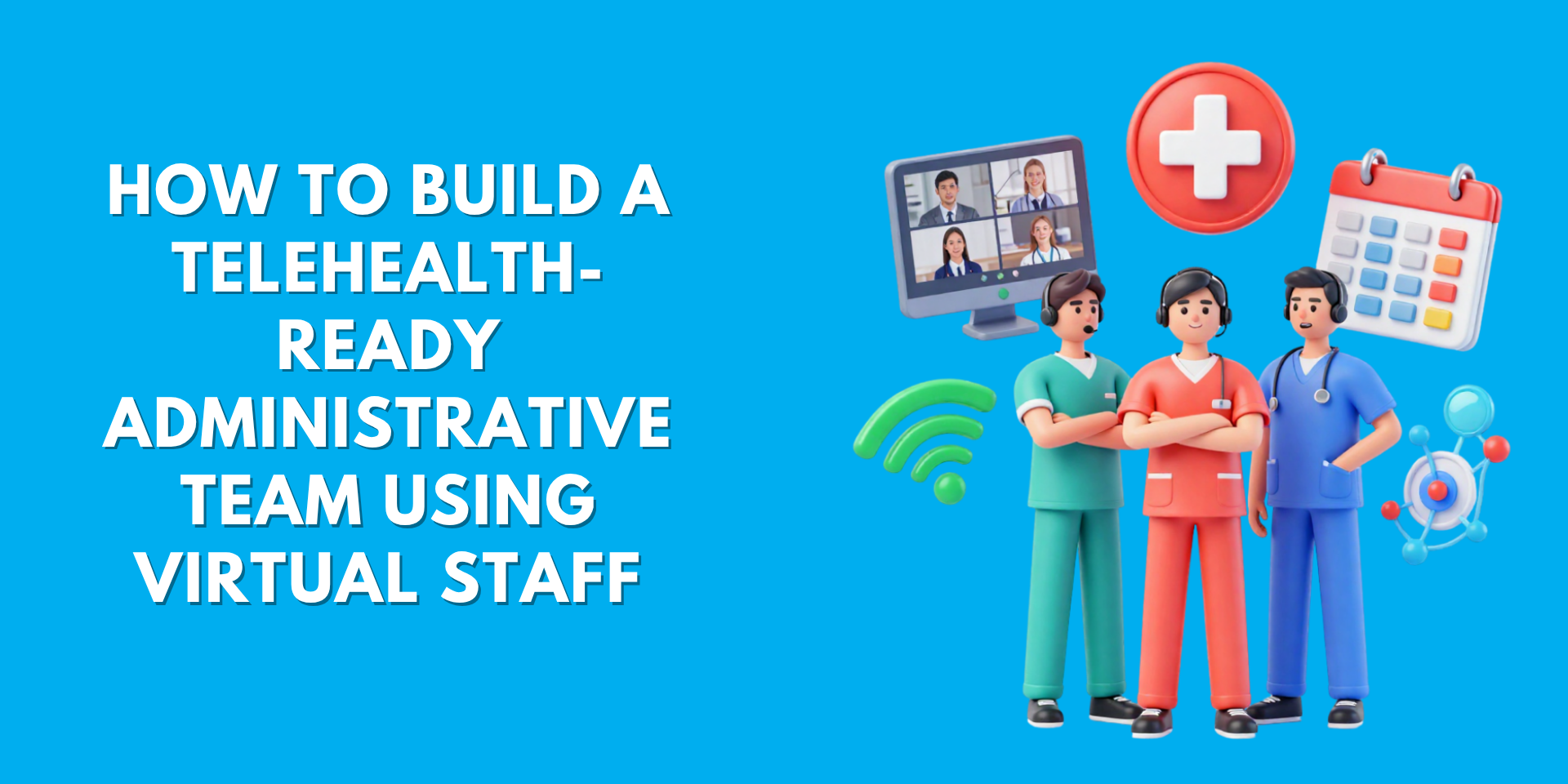
A telehealth-ready administrative team is a group of trained remote professionals who handle the coordination, communication, and documentation work that keeps virtual appointments running — from initial scheduling through post-visit follow-up.
Unlike a single virtual assistant hired to help with overflow tasks, a well-built telehealth admin team uses role-specific assignments so each function is handled by someone trained for it. This is the same operational logic behind any high-performing medical front office — just distributed remotely.
Virtual healthcare staff supporting a telehealth program may include:
- Virtual Medical Receptionists — inbound call handling, appointment booking, and patient communication
- Virtual Medical Admins — documentation management, EHR updates, and back-office coordination
- Remote Patient Care Coordinators — patient outreach, post-visit follow-up, and care continuity
- Appointment Schedulers — calendar management and telehealth slot optimization
- Insurance Verification Specialists — eligibility checks before virtual visits
- Medical Virtual Assistants — task-specific support across administrative functions
Every virtual staff member placed through Virtual Medical Staffing operates under a signed Business Associate Agreement (BAA) — a required HIPAA legal contract that establishes accountability for the handling of protected health information. This is standard on every placement, not optional. For telehealth practices handling sensitive patient data across digital platforms, that protection is foundational. Learn more about our HIPAA compliance and data security standards.
Ready to build your telehealth admin team? Contact Virtual Medical Staffing to discuss your practice’s needs and get matched with pre-vetted, HIPAA-trained virtual staff.
Step 1: Identify Which Administrative Tasks Can Be Handled Remotely
The first step is mapping your current administrative workflow against what actually requires physical presence — and what does not. Most of the coordination work involved in telehealth has no dependency on an in-office location. It simply requires secure system access, trained staff, and defined processes.
Tasks your virtual administrative staff can handle for telehealth include:
- Scheduling and confirming telehealth appointments
- Distributing and following up on patient access links
- Managing digital intake forms and pre-visit documentation
- Conducting insurance verification before virtual visits
- Updating EHR and EMR records after appointments
- Coordinating referrals, follow-up visits, and prescription assistance
- Managing provider calendars across in-person and virtual slots
- Handling patient outreach, reminders, and no-show recovery
Moving these tasks to virtual staff reduces the burden on your in-office team and gives your telehealth program the dedicated administrative attention it actually needs.
Step 2: Create Clear, Documented Telehealth Workflows
Virtual staff perform best — and integrate fastest — when workflows are clearly documented before they start. Without standardized processes, even the most capable virtual team will hit friction points that slow operations and create gaps in the patient experience.
According to HHS’s telehealth workforce development guidelines, clearly defined roles and responsibilities are the most important factor in any telehealth staff structure. The same principle applies to virtual staff.
Before onboarding virtual administrative staff, document the following:
- Appointment scheduling procedures (how slots are created, confirmed, and filled)
- Patient onboarding instructions for first-time telehealth users
- How telehealth platform links are generated and distributed
- Pre-visit reminder cadences (when, how, and through which channel)
- Technical troubleshooting steps for common platform access issues
- Escalation protocols when something goes wrong before or during a visit
- Post-visit documentation and follow-up communication standards
Consistency in these workflows is especially important as patient volumes grow or when multiple virtual staff members are supporting the same providers.
Step 3: Train Virtual Staff on Your Telehealth Platforms and Systems
A telehealth-ready team needs more than general medical administrative knowledge. They also need to understand the specific technology involved in virtual care delivery at your practice.
During onboarding, virtual staff should be trained on your:
- Telehealth software platform (Doxy.me, Zoom for Healthcare, Doceree, etc.)
- EHR or EMR system and documentation standards
- Patient communication tools (portal messaging, SMS reminders, email)
- Scheduling software and calendar coordination procedures
- Provider preferences for appointment types and patient flow
A well-designed virtual medical assistant onboarding process reduces the time between placement and full productivity — and sets your virtual staff up to function as a true extension of your in-house team rather than an external contractor managing from a distance.
Step 4: Strengthen Patient Communication Before Every Appointment
One of the most consistent drivers of telehealth no-shows and appointment failures is poor pre-visit communication. Patients forget. They get confused by the link. First-time users don’t know what to expect. And when no one follows up, the appointment slot is lost.
Virtual administrative staff add a dedicated communication layer that most in-office teams simply don’t have time to maintain. This includes:
- Appointment confirmation messages (same-day booking + 24-hour reminder)
- Telehealth access link delivery with step-by-step platform instructions
- Outreach to patients who haven’t completed their intake forms
- First-time telehealth user guidance (what to have ready, how to test the connection)
- A follow-up touchpoint after missed or cancelled appointments
Practices that formalize this pre-visit communication sequence consistently report reductions in no-show rates and fewer appointment-day technical disruptions — which protects provider time and improves patient satisfaction scores without adding any in-office headcount.
Step 5: Assign Dedicated Roles Within the Virtual Team
As your telehealth program grows, role clarity becomes one of the most important operational decisions you’ll make. A team where everyone does everything is a team where critical tasks fall through the cracks.
Assigning dedicated responsibilities by function creates accountability, prevents duplicated work, and allows each virtual team member to build speed and expertise in their specific area. A basic role structure might look like:
- Scheduler — owns the telehealth calendar, manages slots, and coordinates provider availability
- Patient communicator — handles reminder outreach, intake follow-up, and access link distribution
- Insurance verifier — confirms eligibility and benefits before every virtual visit
- Virtual receptionist — manages inbound calls and patient inquiries in real time
- Care coordinator — handles post-visit follow-up, referral coordination, and care continuity
This structure doesn’t require five separate hires from day one. Many practices start with one or two virtual staff members and expand as patient volume and telehealth demand grow.
Step 6: Use Virtual Staff to Support Hybrid Scheduling
Hybrid care models — where providers see some patients in person and others virtually within the same day — create scheduling complexity that requires active management, not passive oversight.
Without dedicated scheduling support, practices frequently run into double-bookings, provider downtime between mismatched appointment types, and uneven patient flow that leaves some slots overbooked and others empty.
Virtual scheduling staff can monitor provider calendars in real time, balance telehealth and in-person slots, and flag conflicts before they become problems. This is especially important for multi-provider practices where multiple calendars need to be coordinated simultaneously without creating gaps or overlaps that eat into revenue.
Step 7: Strengthen Post-Visit Follow-Up With Virtual Support
The administrative work doesn’t end when the virtual visit concludes. Patients often need follow-up coordination that, if it falls through, results in disengagement, missed prescriptions, or failure to schedule necessary next steps.
Virtual administrative teams can take ownership of post-visit workflows, including:
- Scheduling follow-up appointments before the patient logs off
- Sending lab order instructions or prescription coordination confirmations
- Referral processing and specialist scheduling
- Billing support and insurance follow-up on telehealth claims
- Patient satisfaction check-ins and communication continuity
This continuity is one of the highest-leverage functions a virtual team provides — and one of the most neglected by practices relying solely on in-office staff to handle both clinical and administrative post-visit tasks. See also: how virtual scribes support telehealth documentation efficiency when documentation is part of your post-visit workflow.
What to Look for in a Telehealth Virtual Staffing Partner
Not all virtual staffing providers are built for the specific demands of a medical practice. When evaluating a partner, the criteria that matter most in a telehealth context are:
HIPAA compliance and BAA coverage. Every virtual staff member who touches patient data must be HIPAA trained, and the staffing relationship must be covered by a signed Business Associate Agreement. This is non-negotiable for any practice accepting insurance or handling protected health information.
Medical administrative experience. Generic virtual assistants who haven’t worked in healthcare settings need extensive training before they’re functional. Look for staff who already understand EHR documentation standards, medical terminology, insurance verification workflows, and the compliance expectations of a clinical environment.
Dedicated placement, not pooled resources. A shared VA who rotates between multiple clients cannot develop the system familiarity and workflow consistency that telehealth administration requires. Dedicated placement means your virtual staff member works for your practice, learns your processes, and functions as a real extension of your team.
Physician-founded oversight. Virtual Medical Staffing was founded by Dr. Jordi Livi, a practicing physician, specifically to solve the administrative challenges he experienced in his own clinic. That clinical perspective informs every placement decision — and it means our vetting standards are built around what actually works in a medical practice, not just what looks good on a hiring checklist.
📞 Let’s build your telehealth admin team. Contact Virtual Medical Staffing today — tell us about your practice, your telehealth setup, and the gaps you’re trying to close. We’ll match you with pre-vetted, HIPAA-trained virtual staff ready to integrate into your workflow.
Key Takeaway
Telehealth success depends on more than your platform and your providers. The patient experience — from scheduling through follow-up — is built on the administrative infrastructure running underneath every virtual appointment.
A well-built team of virtual administrative staff handles scheduling, patient communication, intake, insurance verification, and post-visit coordination so your in-office team can stay focused on the patients in front of them.
Virtual Medical Staffing places pre-vetted, HIPAA-trained virtual staff with a signed BAA on every placement — and builds your team around your specific telehealth and hybrid care workflow. Learn more and get started here.
Frequently Asked Questions
What does a telehealth-ready administrative team actually do?
A telehealth-ready administrative team manages the full range of coordination tasks that keep virtual appointments running — including patient scheduling, access link distribution, digital intake follow-up, insurance verification, EHR documentation updates, and post-visit care coordination. These functions are handled by trained remote professionals who integrate directly into the practice’s existing systems and workflows.
Can virtual administrative staff comply with HIPAA for telehealth?
Yes — provided the right protocols are in place. Virtual administrative staff who are properly HIPAA trained, operating through a secure connection, and covered by a signed Business Associate Agreement (BAA) can legally and safely handle protected health information in a telehealth environment. At Virtual Medical Staffing, every placement includes a signed BAA and requires verified HIPAA compliance training before any patient data is accessed.
What roles should be part of a telehealth administrative team?
A functional telehealth administrative team typically includes a scheduler, a patient communication coordinator, an insurance verification specialist, a virtual receptionist, and a care coordinator for post-visit follow-up. Practices with smaller patient volumes often start with one or two of these roles and expand as telehealth demand grows.
How do virtual staff integrate with existing EHR and telehealth platforms?
Virtual administrative staff are trained to work within the practice’s existing systems — including major EHR/EMR platforms and telehealth software tools. The integration process is part of onboarding and typically takes one to three weeks depending on the complexity of the practice’s workflow. No new platform or infrastructure change is required.
How quickly can a virtual telehealth administrative team be onboarded?
Most practices can have virtual staff operational within two to four weeks. The timeline depends on the complexity of the workflow documentation, system access provisioning, and the specific roles being filled. Practices with well-documented processes onboard faster. See our virtual medical assistant onboarding guide for a step-by-step overview of what to expect.
Does hiring virtual administrative staff reduce telehealth no-show rates?
Yes — particularly when virtual staff are assigned to manage pre-visit patient communication. Dedicated reminder outreach, access link delivery, and intake form follow-up consistently reduce the communication gaps that cause no-shows. Practices that formalize this pre-visit touchpoint sequence report meaningful improvements in appointment completion rates without requiring additional in-office staffing resources.
Hybrid Care Requires Administrative Infrastructure That Can Keep Up
Healthcare delivery is moving faster than most administrative teams were built to handle. Patients now expect convenient scheduling, responsive communication, and digital access to care as standard features — not premium ones.
Practices that continue to rely on traditional front desk models alone will face growing friction as hybrid care expands. The practices positioned to grow are building flexible, scalable administrative infrastructure that can support both virtual and in-person care without overloading the in-house team.
Virtual administrative staff give practices the operational capacity to meet modern patient expectations — and the compliance foundation to do so safely. For any practice running telehealth services today, building that infrastructure isn’t a long-term consideration. It’s an immediate operational need.
Contact Virtual Medical Staffing to get started.