
Growing a private practice is exciting — but it’s also challenging. As patient volumes increase and operations become more complex, the administrative burden can quickly overwhelm your clinical team. Appointment scheduling, insurance verification, billing, documentation, and patient communication can start to take time away from what really matters: delivering high-quality care.
For clinics ready to scale, the solution isn’t just hiring more staff — it’s building a healthcare administrative “power team.”
Here’s the reality that most practice growth guides skip over: for many private practice owners, the administrative ceiling arrives before the clinical ceiling does. You have the patient demand, the provider capacity, and the vision — but the back-office infrastructure hasn’t kept pace. A survey of private practice owners found that administrative burden ranks among the top challenges for independent practices, with billing inefficiencies, prior authorization delays, and documentation backlog consistently cited as the biggest drains on provider time and revenue. The answer for a growing number of practices isn’t hiring another generalist — it’s building a healthcare administrative team for private practice that’s structured, specialized, and built to scale alongside your clinical growth.
What Is an Admin Power Team?
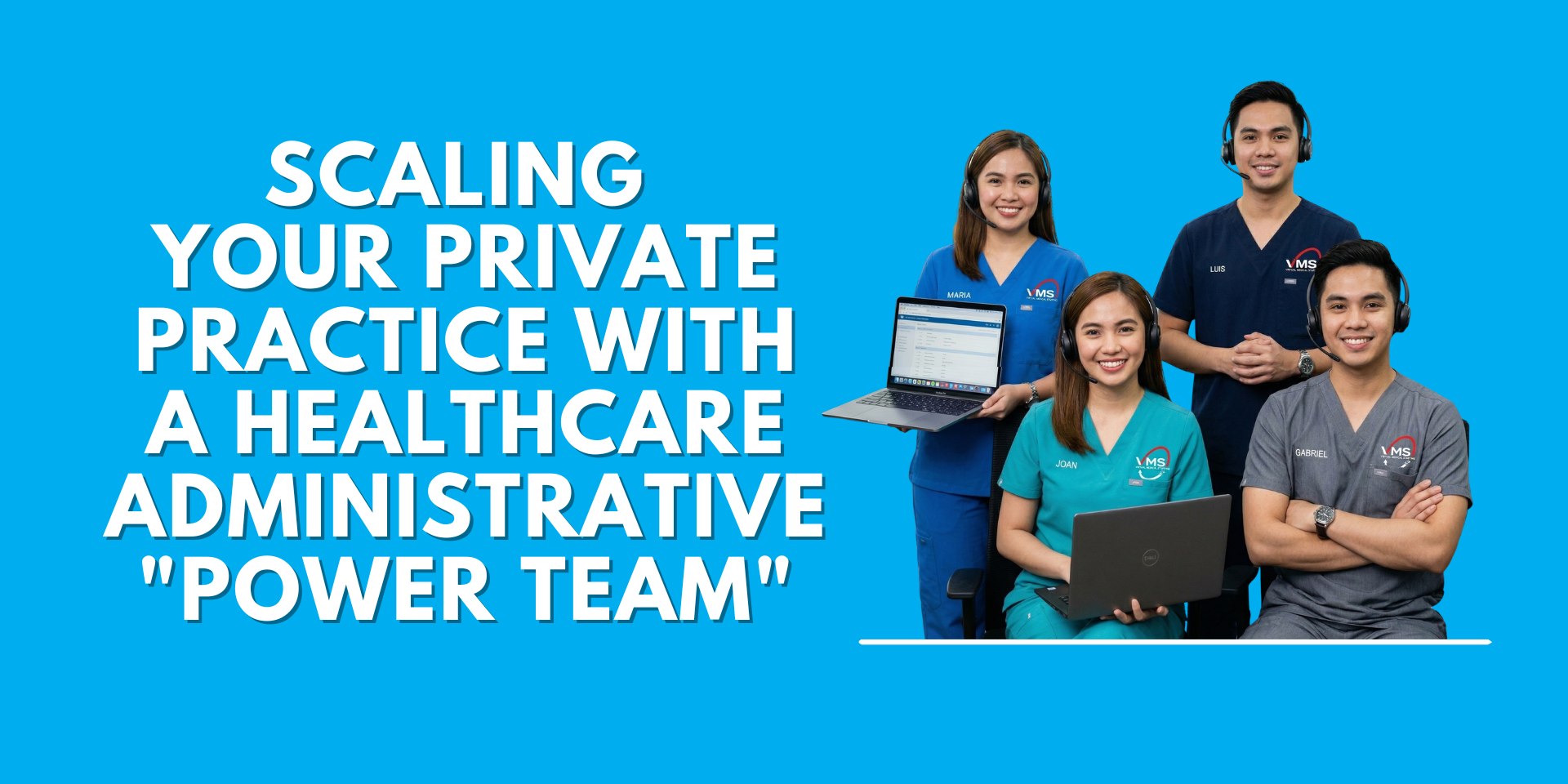
An admin power team is a dedicated group of skilled administrative professionals who manage the operational backbone of your practice. They handle essential tasks across multiple areas, freeing providers to focus on patient care, clinical growth, and strategic initiatives.
Key roles in a power team might include:
- Scheduling Coordinators: Ensure appointments are booked efficiently, reduce no-shows, and manage provider calendars.
- Medical Billers and Coders: Handle claims accurately, follow up on reimbursements, and maintain compliance with payer requirements.
- Insurance Verification Specialists: Verify benefits, process authorizations, and manage referrals.
- Medical Scribes: Assist providers with timely and accurate documentation to reduce backlog.
- Patient Support Coordinators: Answer inquiries, provide education, and maintain high levels of patient satisfaction.
Together, these roles form a powerhouse that keeps your practice running smoothly and professionally.
Why Growing Clinics Need a Power Team
Many clinics reach a tipping point where growth starts to strain existing staff. Without dedicated administrative support, common pain points include:
- Provider Burnout: Doctors and clinical staff spend too much time on paperwork and administrative tasks.
- Errors and Oversights: Billing mistakes, incomplete documentation, or scheduling conflicts can hurt revenue and patient satisfaction.
- Missed Opportunities: Lack of follow-up with referrals, leads, or insurance claims slows growth.
- Inefficiency: Tasks take longer, workflows become inconsistent, and staff morale suffers.
An admin power team solves these problems by providing focused, professional support in every area of operations.
Is Your Practice at the Administrative Tipping Point?
Before investing in additional support, it helps to confirm that administrative strain — not a clinical or operational issue — is the actual bottleneck. These are the signs that your practice has crossed the threshold:
- Providers are regularly finishing documentation after hours or on weekends
- Billing claims are sitting more than 3–5 days before submission
- Insurance verification is happening after appointments rather than before
- No-show rates are rising because reminder workflows have broken down
- Patient inquiries are going unanswered for more than 24 hours
- You’ve said “I’ll just handle it myself” more than twice this week about an administrative task
- A referral, claim, or follow-up has slipped through the cracks in the past month
If three or more of these are true, your practice isn’t struggling because of a growth problem. It’s struggling because the private practice administrative support infrastructure hasn’t scaled alongside the clinical capacity. The good news: this is a solvable problem — and it doesn’t require building an expensive in-house department to solve it.
Building Your Admin Power Team
Scaling effectively requires more than hiring anyone available. To establish a team that drives success:
Define Clear Roles and Responsibilities. Outline the specific tasks each team member will handle. This prevents overlap, ensures accountability, and helps staff operate efficiently.
Hire Skilled Healthcare Administrative Professionals. Look for candidates with experience in medical billing, coding, scheduling, or patient coordination. Specialized knowledge reduces errors and speeds up processes.
Leverage Virtual Support When Needed. Virtual healthcare administrative assistants can augment your team without the cost of additional in-office staff. They are particularly effective for billing, insurance verification, documentation, and patient follow-ups.
Implement Streamlined Workflows. Use systems that integrate scheduling, billing, documentation, and communication. A well-organized workflow allows your team to handle more tasks accurately and quickly.
Focus on Training and Growth. Even experienced professionals benefit from structured training in your clinic’s specific systems and protocols. Continuous improvement ensures your team stays efficient as your practice expands.
Virtual vs. In-House Healthcare Admin: What Growing Practices Are Choosing
The traditional assumption for private practices has been that administrative staff must be physically present. That assumption is increasingly being reconsidered — and for good reason.
In-house administrative staff offer familiarity and physical presence, but come with significant overhead: salary, benefits, paid leave, office space, equipment, and turnover costs that compound over time. For a growing practice that needs specialized roles across billing, insurance verification, scribing, and patient coordination, hiring four or five in-office staff members represents a substantial fixed cost — before a single claim is submitted.
Virtual healthcare administrative assistants — particularly those trained in medical billing, HIPAA-compliant communication, and healthcare-specific platforms — deliver the same functional support at a fraction of the overhead. They operate within your existing systems remotely, handle high-volume tasks consistently, and can be scaled up or down as patient volume shifts.
The distinction that matters for private practices: a healthcare virtual assistant is not a general VA. They bring specialized knowledge of medical billing workflows, prior authorization processes, documentation standards, and patient communication protocols that a generalist simply does not have. For a scale private medical practice strategy to work, the support team needs to be as clinically literate as it is operationally capable.
For many growing clinics, a hybrid model works best: one or two in-office coordinators handling physical intake and provider-facing tasks, supported by a virtual medical billing and administrative support team managing the back-office work that doesn’t require physical presence.
HIPAA Compliance and Virtual Admin Staff: What You Need to Know
One of the most common hesitations practice owners have about virtual administrative support is compliance. If someone is handling patient scheduling, billing data, or insurance records remotely, how do you ensure HIPAA standards are maintained?
This is the right question — and it has a clear answer.
A properly structured virtual medical staffing arrangement includes:
- Business Associate Agreements (BAAs): Any virtual admin staff member who handles Protected Health Information (PHI) must be covered under a signed BAA — the same requirement that applies to any third-party handling patient data.
- Secure Access Protocols: Remote staff should access your systems through encrypted connections, role-based permissions, and HIPAA-compliant platforms — not through personal email or unsecured channels.
- Training and Accountability: Healthcare-specific virtual staffing providers ensure their staff are trained in HIPAA requirements, understand what constitutes PHI, and follow documentation and communication protocols that meet compliance standards.
- Audit Trails: Most EHR and practice management systems provide access logs — remote staff activity is trackable, reviewable, and auditable in the same way in-office staff activity is.
Working with a staffing partner that specializes in healthcare — not a general VA platform — is what makes the compliance difference. The right partner doesn’t just match you with a skilled professional; they ensure that professional operates within the standards your practice requires.
The Impact of a Power Team on Your Practice
A well-structured admin team transforms your clinic from reactive to proactive:
- Increased Productivity: Providers can focus on patient care while administrative tasks are handled efficiently.
- Revenue Growth: Accurate billing, prompt claim submissions, and effective follow-ups improve cash flow.
- Patient Satisfaction: Timely communication, easy scheduling, and consistent care experiences keep patients happy.
- Scalable Operations: Your practice can grow without adding unnecessary stress to your team.
Simply put, your admin power team is the driving force behind long-term growth.
What a Week Looks Like — Before and After a Power Team
It’s one thing to list the benefits of administrative support. It’s another to picture what changes in practice.
Before a power team: Your physician finishes their last appointment at 5:30 PM. Instead of leaving, they spend another 45 minutes completing documentation that fell behind during the day. A billing claim from last Tuesday still hasn’t been submitted because the front desk coordinator was managing phone calls. A patient who called twice about their insurance authorization hasn’t heard back. Two referrals are sitting in an email inbox, untracked.
After a power team: The same physician finishes their last appointment at 5:30 PM and leaves by 5:45. A medical administrative assistant completed documentation support throughout the day, so nothing carries over. Billing claims are submitted within 24 hours of service. The insurance verification specialist confirmed authorizations before this morning’s appointments. Referrals are tracked, followed up, and documented. The patient who called about their authorization received a response before noon.
The clinical work is identical. The administrative infrastructure changes everything around it.
This is what a properly built healthcare administrative team for private practice delivers — not just efficiency, but the kind of operational reliability that lets providers do their best work without carrying the weight of a back office that isn’t keeping up.
Why Virtual Medical Staffing Is the Fastest Path to Building Your Power Team
Building a healthcare administrative team the traditional way — posting roles, interviewing candidates, onboarding in-house staff one by one — takes months and requires ongoing management overhead that most growing practices don’t have capacity for.
Virtual Medical Staffing (VMS) was built specifically to solve this problem for healthcare practices.
We place trained, healthcare-experienced administrative professionals across every role described in this post — scheduling coordinators, medical billers and coders, insurance verification specialists, medical scribes, and patient support coordinators. Every professional we place understands HIPAA requirements, is familiar with healthcare-specific workflows, and is matched to your practice’s specialty, systems, and operational needs.
You don’t build your power team from scratch. You partner with VMS, and we put the right professionals in place — quickly, compliantly, and at a cost structure that makes scaling sustainable rather than financially stressful.
To Sum It All
Scaling a private practice isn’t just about attracting more patients — it’s about building systems and teams that support sustainable growth. A dedicated healthcare administrative power team ensures your operations run smoothly, providers stay focused, and patients receive consistent, high-quality care.
For growing clinics, investing in a skilled administrative team isn’t optional — it’s strategic. The right team lets your practice thrive, expand, and reach its full potential.
Ready to Build Your Practice’s Admin Power Team?
If this post has described your practice’s current situation more than once, the next step isn’t another round of research. It’s a conversation.
At Virtual Medical Staffing, we specialize in placing experienced, HIPAA-aware healthcare administrative professionals for private practices that are ready to scale without sacrificing clinical quality or burning out their providers. Whether you need one specialist to close a specific gap or a full power team built from scratch, we make the process straightforward.
Your practice’s growth deserves the right support behind it. Reach out to VMS today and let’s build the administrative foundation your next stage of growth requires.