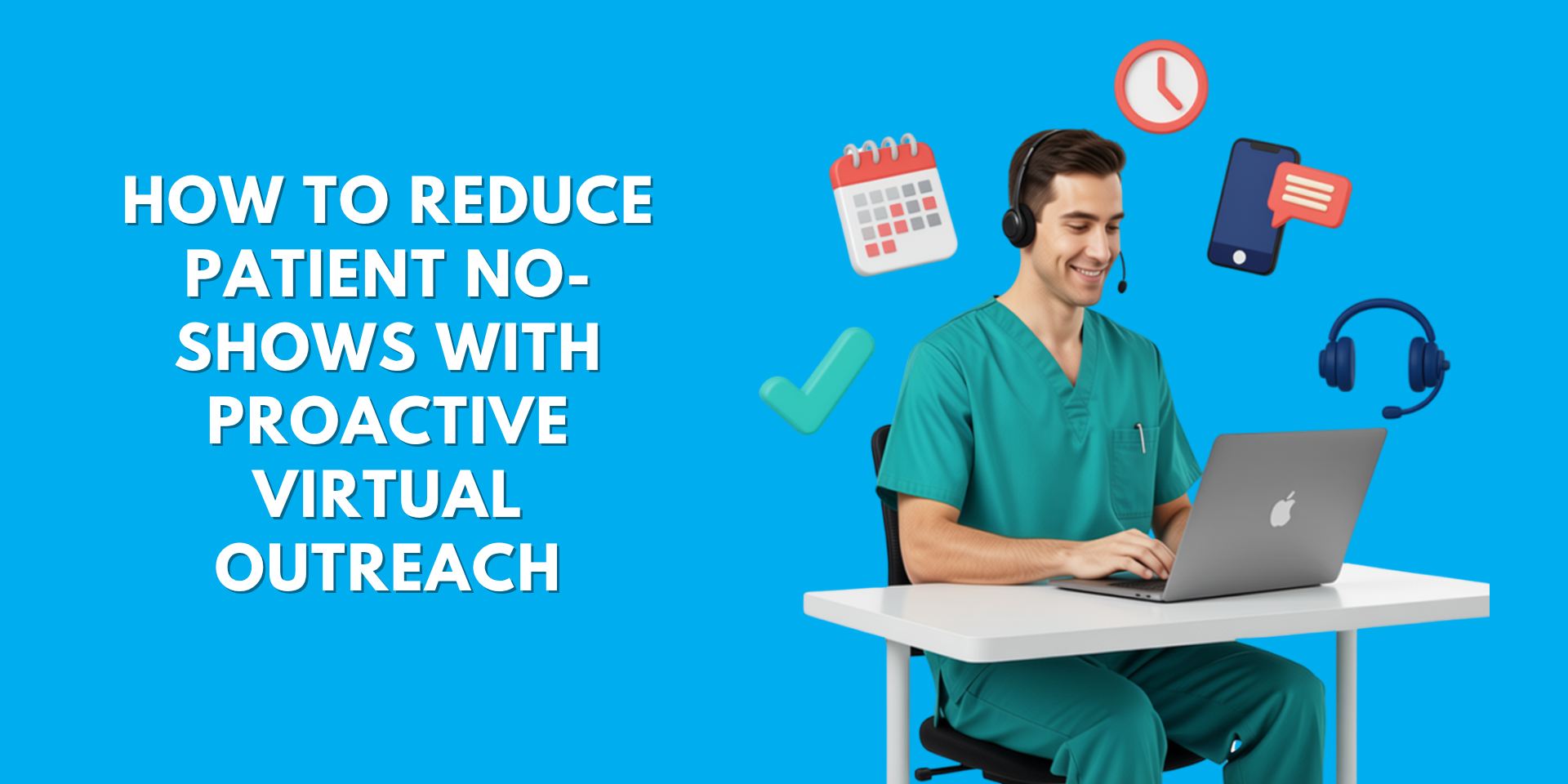
Reducing patient no-shows comes down to one thing: proactive, consistent communication before, during, and after every appointment. Practices that combine multi-channel reminders (SMS, email, and voice), tracked confirmations, easy rescheduling, and targeted outreach to high-risk patients typically see meaningful drops in missed appointments — often without adding a single in-house staff member. Virtual medical assistants make this level of consistency possible at a fraction of the cost of expanding front-desk staff.
Patient no-shows are one of the most persistent operational challenges in healthcare practices. They disrupt schedules, reduce revenue, and create inefficiencies that affect both staff workflow and patient care continuity. The good news is that most missed appointments are preventable with a structured, proactive outreach system — especially one supported by trained virtual medical receptionist services.
By leveraging virtual teams for patient communication, practices can significantly improve attendance rates, streamline scheduling, and enhance the overall patient experience.
Why Patient No-Shows Happen
Before addressing solutions, it’s important to understand why patients miss appointments in the first place. Common reasons include:
- Forgetting the appointment date or time
- Lack of reminders or follow-ups
- Transportation or scheduling conflicts
- Confusion about appointment details
- Low perceived urgency or importance
- Difficulty rescheduling
Most of these issues can be addressed through consistent communication and proactive engagement — not through penalties. In a 2025 MGMA Stat poll, practice leaders who reported rising no-show rates most often pointed to patient indifference, transportation barriers, and cost pressures rather than a single fixable cause, which is why a layered communication strategy tends to outperform a one-size-fits-all reminder.
The True Cost of Patient No-Shows
No-show rates vary widely by specialty and region, but the financial impact is consistent across the board. Benchmark no-show rates typically run 5–8% for well-managed primary care practices, though industry data puts the broader primary care average closer to 19%, with pediatrics, dermatology, and sleep medicine often running significantly higher. Each missed visit represents lost provider time, wasted overhead, and a gap in patient care continuity — and industry cost analyses commonly put the price of a single no-show at roughly $200 once lost revenue and staff time are factored in.
The pattern that matters most for practice owners: a single no-show materially increases the odds a patient won’t return at all, which makes no-show reduction a retention strategy, not just a scheduling fix.
The Role of Proactive Virtual Outreach
Virtual medical staff play a key role in reducing no-shows by maintaining continuous patient communication before, during, and after appointments. Unlike reactive systems that only respond when issues arise, proactive outreach focuses on prevention.
A structured virtual outreach system typically includes:
- Appointment confirmations
- Automated and manual reminders
- Pre-visit instructions
- Follow-up messages for missed appointments
- Easy rescheduling support
When done consistently, this approach significantly improves attendance rates. Practices that rely on ad hoc, front-desk-only reminders tend to see attendance suffer whenever staff are pulled onto other tasks — which is exactly the gap a dedicated virtual medical assistant scheduling workflow is built to close.
Appointment Reminders That Actually Work
Not all reminders are equally effective. The most successful practices use a combination of timing and communication channels, and the research backs this up: a randomized controlled trial in a pediatric outpatient clinic found the no-show rate dropped to 23.5% among patients who received a text reminder in addition to a standard voice reminder, compared with 38.1% for the voice-only control group — a statistically significant 14.6 percentage-point difference. A separate study of targeted reminders for high-risk visits found that sending an additional text message reduced the relative risk of a no-show by roughly 7% in primary care and closer to 11% in mental health visits.
Virtual staff can help manage:
- SMS reminders 48 hours before the appointment
- Email reminders with full appointment details
- Same-day reminders for high-risk no-show patients
- Personalized messages based on patient history
Personalization is especially important. Patients are more likely to respond when communication feels direct and relevant.
Reminder Channel Effectiveness at a Glance
| Channel | Typical Impact on No-Shows | Best Use Case |
|---|---|---|
| SMS/text | Strongest single-channel effect; high open rates | Primary reminder for most patients, 48 hrs and same-day |
| Automated voice/IVR call | Moderate effect; less consistent than text | Patients without reliable text access |
| Live phone call (staff or VA) | Highest personal-touch effect, but time-intensive | High-risk or previously no-showed patients |
| Weakest standalone effect | Supplemental detail (directions, forms, pre-visit prep) |
HIPAA-Compliant Outreach: What Practices Need to Know
A common concern with text- and email-based outreach is compliance. The U.S. Department of Health and Human Services has confirmed that appointment reminders are permitted under the HIPAA Privacy Rule without a separate patient authorization, because reminders are considered part of a patient’s treatment. That doesn’t mean anything goes, though — reminders still need to follow the “minimum necessary” standard, which means keeping messages limited to appointment logistics (date, time, provider, location) and avoiding diagnoses, procedures, or other protected health information. Practices using SMS or automated platforms also need a signed Business Associate Agreement with their messaging vendor.
Virtual medical assistants trained on these safeguards — see our overview of HIPAA-compliant data security practices — can manage this outreach without exposing the practice to compliance risk.
Confirmation Systems That Reduce Uncertainty
One of the simplest ways to reduce no-shows is to require and track appointment confirmations.
Virtual staff can:
- Send confirmation requests after scheduling
- Flag unconfirmed appointments
- Follow up with patients who have not responded
- Update the schedule based on confirmed attendance
This helps practices identify potential no-shows early and take action before the appointment date, giving front-desk staff time to fill the slot from a waitlist instead of absorbing the loss.
Making Rescheduling Easy and Accessible
Many no-shows happen because patients find it difficult to reschedule. A proactive outreach system removes this barrier.
Virtual medical staff can:
- Offer flexible rescheduling options
- Proactively reach out when conflicts are detected
- Provide alternative time slots
- Update calendars in real time
When rescheduling is simple, patients are more likely to communicate changes instead of missing appointments entirely.
Identifying High-Risk No-Show Patients
Not all patients carry the same risk of missing appointments. Virtual teams can help identify patterns by tracking:
- History of missed appointments
- Late cancellations
- Communication responsiveness
- Appointment type sensitivity
With this data, practices can apply more frequent reminders or personalized outreach for high-risk patients — the same targeted approach used by a virtual care coordinator for high-risk patient management, where consistent contact is often the difference between a patient staying engaged in their care plan or falling out of the system entirely. For practices managing a heavier caseload of chronic-condition patients, a dedicated patient care coordinator can take ownership of this tracking so it doesn’t fall through the cracks.
Post-No-Show Follow-Up Matters
What happens after a missed appointment is just as important as preventing it. Virtual staff can help re-engage patients by:
- Sending polite follow-up messages
- Offering immediate rescheduling options
- Documenting reasons for no-shows
- Updating patient records for future reference
This keeps patients connected to the practice and reduces long-term disengagement — and it directly supports the kind of improving patient satisfaction scores work practices are already trying to do without adding in-office headcount.
Integrating Virtual Outreach Into Practice Systems
To be effective, proactive outreach must be systemized rather than handled inconsistently. Practices should ensure:
- Clear communication workflows
- Standardized reminder schedules
- Defined roles for virtual staff
- Integration with the clinic’s scheduling system
- Ongoing performance tracking
When these systems are in place, virtual staff can operate efficiently and consistently. This is where remote healthcare administration support and dedicated virtual intake specialists tend to work best together — intake handles the first touchpoint, administration keeps the reminder and confirmation cadence running in the background.
Ready to see what a structured no-show reduction system would look like for your practice? Book a free consultation and we’ll walk through where the gaps are in your current scheduling workflow.
Frequently Asked Questions
How much do patient no-shows actually cost a practice?
Industry cost analyses commonly estimate around $200 in lost revenue and overhead per missed appointment, though the exact figure depends on visit type, provider rate, and specialty. A practice with even a 10% no-show rate can lose tens of thousands of dollars a year in unfilled slots.
Are text message appointment reminders HIPAA compliant?
Yes, when done correctly. HHS confirms appointment reminders are permitted without patient authorization since they’re considered part of treatment, but messages should stick to logistics only (date, time, provider) and avoid clinical details, and any texting platform used should be covered by a Business Associate Agreement.
How far in advance should reminders be sent?
Most practices see the best results from a layered approach: an initial reminder 48 hours before the appointment, followed by a same-day reminder for higher-risk patients. Relying on a single reminder tends to underperform a multi-touch sequence.
Can a virtual medical assistant really replace in-house front-desk staff for this?
A virtual medical assistant doesn’t need to replace your front desk — it typically absorbs the repetitive reminder, confirmation, and rescheduling workload so in-house staff can focus on patients who are physically in the office.
What’s the difference between a reminder and a confirmation system?
A reminder simply notifies the patient of the upcoming appointment. A confirmation system requires the patient to actively respond, which gives staff a clear early signal of which slots are at risk and time to fill them from a waitlist.
Do no-show fees work better than reminders?
Research suggests fees have a modest effect at best, and a meaningful share of patients see them as unfair. Proactive communication — reminders, confirmations, and easy rescheduling — tends to address the root causes of no-shows rather than just penalizing the outcome.
Key Takeaways
Reducing patient no-shows requires more than occasional reminders — it requires a structured, proactive communication system spanning reminders, confirmations, rescheduling support, and post-no-show follow-up. Virtual medical staff are uniquely positioned to manage this process consistently, keeping patients informed, engaged, and accountable for their appointments while staying within HIPAA guidelines.
With the right outreach strategy, healthcare practices can improve attendance rates, optimize schedules, and deliver better continuity of care. If reducing patient no-shows is a priority for your practice, reach out for a free consultation to discuss how a virtual outreach team could fit into your existing workflow.