

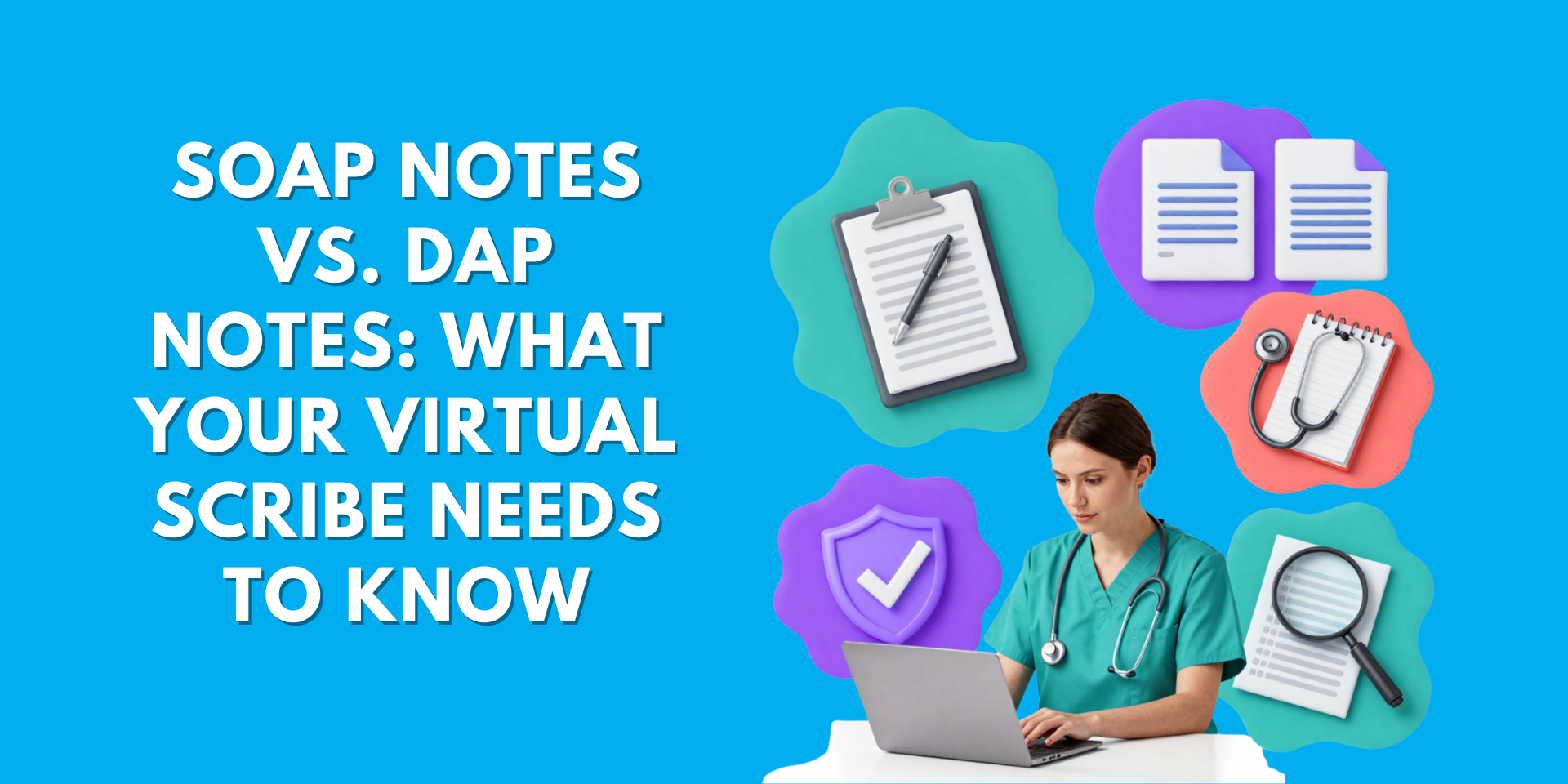
SOAP notes and DAP notes are both structured clinical documentation formats, and the difference is one section. SOAP separates what the patient reports (Subjective) from what the clinician measures (Objective), then adds Assessment and Plan. DAP merges those first two into a single Data section, followed by Assessment and Plan. SOAP is standard in primary care and hospital settings; DAP is common in behavioral health and therapy progress notes.
That is the short answer. The longer answer — the one that determines whether your notes survive a payer audit and whether your virtual scribe saves you two hours a day or creates two hours of rework — is about how you brief the person doing the documenting.
Accurate clinical documentation is the backbone of patient care, compliance, and continuity. For providers working with remote medical scribes or medical virtual assistants, understanding documentation formats is not optional. It directly affects charting speed, billing accuracy, and patient outcomes.
If you’re delegating documentation, knowing when and how each format is used helps you set clearer expectations and avoid costly corrections.
SOAP Notes vs. DAP Notes: Side-by-Side Comparison
| Feature | SOAP Note | DAP Note |
|---|---|---|
| Stands for | Subjective, Objective, Assessment, Plan | Data, Assessment, Plan |
| Number of sections | 4 | 3 |
| Key structural difference | Separates patient-reported information from measurable findings | Combines both into a single “Data” section |
| Typical setting | Primary care, hospitals, urgent care, specialty clinics | Therapy, counseling, behavioral health, case management |
| Level of detail | Higher — granular and highly structured | Leaner — condensed and faster to produce |
| Best for | Complex evaluations, differential diagnosis, multi-problem visits | Recurring progress notes, session-based care |
| Charting speed | Slower per note | Faster per note |
| Audit strength | Strong — objective findings clearly isolated | Adequate, but requires disciplined internal ordering |
| Scribe learning curve | Moderate — requires clinical judgment on S vs. O sorting | Lower — fewer sorting decisions |
The practical takeaway: SOAP forces a sorting decision on every piece of information. DAP removes that decision. Neither is more “correct” — they solve for different tradeoffs between granularity and speed.
What Are SOAP Notes?
SOAP notes are one of the most widely used documentation frameworks in healthcare. The acronym stands for:
- S – Subjective
- O – Objective
- A – Assessment
- P – Plan
The format isn’t arbitrary. It came out of the Problem-Oriented Medical Record developed by Dr. Lawrence Weed in the 1960s, an attempt to make clinical notes follow a scientific method rather than free-form narrative. As documented in the BMJ’s account of the problem-oriented medical record, Weed’s system placed a structured problem list at the front of the record so every clinician involved in a patient’s care could see active and resolved problems at a glance, with SOAP as the mnemonic for recording findings and the reasoning behind any change in the management plan.
That origin matters for scribes: SOAP is not a form to fill in. It mirrors clinical reasoning, moving from patient-reported symptoms to provider conclusions and treatment planning.
Subjective (S)
This section captures what the patient reports:
- Symptoms
- Chief complaint
- History of present illness
- Patient concerns
Example:
“Patient reports persistent headaches for the past 5 days, worse in the morning.”
Objective (O)
This includes measurable, observable data:
- Vital signs
- Physical exam findings
- Lab results
- Imaging results
Example:
“Blood pressure 140/90 mmHg. Neurological exam within normal limits.”
Assessment (A)
This is the provider’s clinical interpretation:
- Diagnosis or differential diagnosis
- Clinical impression
Example:
“Likely tension-type headaches, rule out hypertension-related causes.”
Plan (P)
This outlines the next steps:
- Medications
- Referrals
- Tests
- Follow-up instructions
Example:
“Start NSAIDs as needed. Monitor blood pressure. Follow up in 2 weeks.”
Where scribes most often go wrong with SOAP
The single most common SOAP error is misfiling information between S and O. Patient-reported pain (“patient states pain is 7/10”) is subjective, even though it has a number attached. A scribe’s own observation of patient affect belongs in Objective, not Subjective. Getting this wrong doesn’t just look sloppy — it weakens the note if the record is ever reviewed, because the evidentiary basis for the assessment becomes unclear.
What Are DAP Notes?
DAP notes are a more streamlined alternative. The acronym stands for:
- D – Data
- A – Assessment
- P – Plan
This format removes the separation between subjective and objective information and combines them into a single Data section. Unlike SOAP, DAP has no single documented originator and is best understood as a widely adopted convention in behavioral health rather than a formally standardized clinical requirement — which is exactly why internal consistency matters so much when you use it.
Data (D)
Includes all relevant patient information:
- Patient-reported symptoms
- Clinical observations
- Exam findings
- Test results
Example:
“Patient reports fatigue and dizziness. BP 100/60 mmHg. Pale appearance noted.”
Assessment (A)
Same as SOAP:
- Clinical interpretation
- Diagnosis or impression
Example:
“Possible dehydration or anemia.”
Plan (P)
Same as SOAP:
- Treatment steps
- Orders
- Follow-up
Example:
“Order CBC. Increase fluid intake. Reassess in 1 week.”
The hidden discipline DAP requires
Because DAP collapses two categories into one, it’s tempting to treat the Data section as a dumping ground. Good DAP notes still order information predictably — typically patient report first, then observable findings — so a reviewer can reconstruct what was said versus what was measured. If your practice uses DAP, this internal ordering should be written into your template, not left to each scribe’s instinct.
SOAP vs. DAP: Key Differences
1. Structure
SOAP separates subjective and objective data. DAP combines them into one section.
2. Level of Detail
SOAP is more detailed and structured. DAP is more concise and efficient.
3. Use Case
- SOAP is commonly used in primary care, hospitals, and for detailed evaluations
- DAP is more commonly used in therapy, behavioral health, and progress notes
4. Defensibility Under Review
SOAP’s separation makes it easier to demonstrate that a diagnosis was supported by measurable findings rather than patient report alone. DAP can be equally defensible, but only if the Data section is internally organized. This is why multi-specialty groups often run SOAP as the default and permit DAP only in behavioral health lines. If you’re staffing across several service lines, the virtual medical staff by specialty breakdown is a useful companion read.
Why This Matters for Virtual Scribes
Documentation is where physician time actually goes. And the research on shifting that work to a documentation partner is more specific than most practice owners realize.
A national longitudinal cohort study of 18,265 ambulatory physicians, published in JAMA Internal Medicine, examined what happened when physicians adopted team-based documentation support such as scribes and co-authored notes. The study found that adoption was associated with significant increases in visit volume alongside decreases in documentation time in the EHR, including after-hours EHR time.
The critical finding is the threshold. Physicians for whom less than 40% of note text was authored by another team member saw no time savings at all. Partial delegation produced nothing. Only high-intensity adoption moved the needle.
That single data point should reframe how you think about format instructions. A scribe who has to stop and ask which section a finding belongs in, or who produces notes you rewrite before signing, is a low-intensity adopter by definition — and the research suggests you will capture none of the benefit. Format clarity is not a nicety. It is the mechanism by which delegation becomes intensive enough to pay off.
A scribe who understands both formats can:
- Document faster without clarification delays
- Adapt to provider preference across service lines
- Reduce charting errors
- Improve turnaround time for notes
Inconsistency in format instructions leads to:
- Incomplete documentation
- Billing issues
- Compliance risks
- Time-consuming corrections
The downstream effect on chart integrity is significant enough that it’s worth reading how a medical virtual assistant improves EHR accuracy alongside this piece, and how documentation support connects to reducing physician burnout with remote scribes.
The Compliance Rule Most Practices Get Wrong
Before you finalize any documentation workflow, understand who signs.
Under Medicare rules, scribes are not providers of items or services. According to CMS guidance on complying with Medicare signature requirements, CMS does not require the scribe to sign or date the documentation. The treating physician’s or non-physician practitioner’s signature on the note is what affirms that the note adequately documents the care provided, and reviewers are directed to look for that signature and date.
Three practical implications:
- The signature is not a formality. By signing, you are attesting that the note is accurate. A scribe’s error becomes your error the moment you sign.
- Signatures should not be added late. CMS directs providers to use the attestation process rather than adding late signatures beyond the short delay inherent in transcription.
- Format compliance is your responsibility, not the scribe’s. If you never specified SOAP vs. DAP, an inconsistent chart is a workflow failure, not a staffing one.
Note also that CMS signature rules are one layer. Accrediting bodies and individual payers may impose additional requirements around scribe role identification and entry timing, and state-level or specialty-specific rules can apply. Confirm requirements with your own compliance officer and payer contracts before finalizing a scribe policy. Practices building this from scratch may also want to review our HIPAA compliance and data security standards for remote documentation staff.
How to Choose: SOAP or DAP?
Use this decision sequence:
Choose SOAP when:
- You’re in primary care, urgent care, hospital medicine, or a procedural specialty
- The visit involves differential diagnosis or multiple active problems
- The encounter is an initial evaluation or comprehensive assessment
- Your payer mix includes plans with a history of documentation review
- Multiple clinicians will read the note
Choose DAP when:
- You’re in behavioral health, therapy, counseling, or case management
- The note is a recurring progress note within an established treatment plan
- Subjective and objective data are difficult to meaningfully separate
- Session-based volume makes charting speed the binding constraint
Choose both — explicitly mapped — when:
- You run multiple service lines under one organization
- In this case, document the mapping (e.g., “SOAP for all medical visits, DAP for behavioral health sessions”) and hand it to your scribe on day one rather than letting it emerge through correction.
Your EHR also shapes this decision, since template flexibility varies considerably between platforms. Our comparison of Epic vs. athenahealth vs. DrChrono for virtual scribes covers how each handles structured note templates.
Ready to hand off your documentation?
Our trained remote medical scribes work in both SOAP and DAP formats, adapt to your EHR, and follow your templates from the first shift — not the fifth week.
Setting Your Virtual Scribe Up for Success
To maximize efficiency, providers should:
1. Specify the format clearly
Don’t assume your scribe knows your preference. State it upfront:
“Use SOAP format for all primary care visits.”
2. Standardize templates
Provide examples or templates your scribe can follow consistently. A single annotated gold-standard note for each visit type is worth more than a page of written instructions.
3. Define expectations
Clarify:
- Level of detail required
- Abbreviation preferences
- Documentation timing
4. Train on your workflow
Even experienced scribes need orientation to your:
- Specialty
- Patient population
- EHR system style
5. Build in a review loop for the first 30 days
Set a defined checkpoint — a short weekly review of a sample of notes for the first month — with a clear end date. The goal is to reach the point where you’re signing notes rather than rewriting them, which is precisely the high-intensity delegation threshold the research identifies as the point where time savings begin.
Our step-by-step guide to onboarding a virtual medical assistant covers this ramp-up in detail. For practices where note quality has already slipped, a dedicated documentation review specialist can audit and correct the existing record alongside forward-going documentation.
Frequently Asked Questions
What is the difference between SOAP notes and DAP notes?
SOAP notes have four sections — Subjective, Objective, Assessment, Plan — and keep patient-reported information separate from measurable clinical findings. DAP notes have three sections — Data, Assessment, Plan — and combine subjective and objective information into a single Data section. SOAP is more detailed; DAP is faster to produce.
Which format should a virtual medical scribe use?
Whichever format the provider specifies. SOAP is the default for primary care, hospital, and specialty medical visits. DAP is standard in behavioral health and therapy progress notes. A qualified virtual scribe should be fluent in both and follow the practice’s documented preference rather than defaulting to a personal habit.
Are DAP notes acceptable for insurance billing?
Yes. Payers evaluate whether documentation supports the level of service billed, not which acronym structures the note. A well-organized DAP note that clearly records patient presentation, clinical assessment, and plan can support a claim. The risk with DAP is not the format itself but disorganized Data sections that make the basis for the assessment hard to follow.
Does a medical scribe have to sign the note?
No. CMS does not require a scribe to sign or date the documentation. The treating physician’s or non-physician practitioner’s signature and date are what authenticate the note and affirm it adequately documents the care provided. Accrediting bodies and individual payers may add their own requirements, so confirm with your compliance officer.
Can a practice use both SOAP and DAP notes?
Yes, and multi-service-line organizations frequently do. The requirement is an explicit written mapping of which format applies to which visit type, provided to documentation staff at onboarding. Ambiguity — not the coexistence of two formats — is what causes inconsistent charts.
How long does it take a virtual scribe to learn a practice’s documentation format?
With annotated template examples and a defined review loop, most experienced scribes reach consistent output within two to four weeks. The variable that most affects the timeline is the clarity of the initial brief, not the scribe’s experience level.
Key Takeaways: SOAP Notes vs. DAP Notes
SOAP and DAP notes are not competing systems. They are tools for different clinical needs.
- SOAP notes separate Subjective from Objective across four sections, and suit primary care, hospitals, and detailed evaluations
- DAP notes merge those into a single Data section across three, and suit behavioral health and recurring progress notes
- The choice is the provider’s, and it must be stated explicitly rather than assumed
- The signature is always the provider’s, and it carries the attestation
- Partial delegation doesn’t pay — research on team-based documentation found no time savings below roughly 40% of note text authored by a documentation partner
The real advantage comes not from choosing one format over the other, but from ensuring your documentation process is consistent, efficient, and aligned with your workflow. For virtual scribes, clarity is everything. The better your instructions, the better your documentation — and ultimately, the better your patient care.
If your goal is to scale efficiently, your documentation system is one of the first processes worth standardizing.
Standardize Your Documentation — Starting This Month
You don’t need to redesign your charting workflow alone. Virtual Medical Staffing places trained medical scribes and documentation specialists who work in your EHR, in your format, following your templates.
Book a free consultation and we’ll map your documentation workflow, identify where notes are costing you time, and scope the support your practice actually needs.